The Brain as a Critical System
An overview of the evidence that the brain operates near a critical state, and why this matters for understanding brain disorders.
Simon-Shlomo PoilOn this page
This essay was written in 2013 based on my PhD research at VU University Amsterdam. Since then, the brain criticality literature has developed further, including important debates about sub-critical regimes, improved statistical tests for power-law claims, and more careful discussion of when criticality language is warranted. The core concepts and evidence described here remain foundational to the background of my current work. The underlying concepts are introduced in Introduction to Self-Organised Criticality and Branching Processes, and the method behind the long-range temporal correlation results is in the DFA tutorial.
Many studies have suggested that the brain operates near a so-called self-organised critical state (Bak, 1996; Chialvo and Bak, 1999; Linkenkaer-Hansen et al., 2001; Beggs and Plenz, 2003; Chialvo, 2004, 2007, 2010; Poil et al., 2008; He et al., 2010; Shew and Plenz, 2012; Beggs and Timme, 2012). In this view, brain activity is neither fully uncorrelated nor overly rigid, but organised in a regime with scale-free dynamics across time and events.
The concept of criticality comes from statistical physics, where certain systems — such as the Ising model of ferromagnetism — undergo a phase transition and exhibit scale-free behaviour (Christensen and Moloney, 2005). Bak et al. (1987) described a wide class of systems that reach a critical state through a process of self-organisation, which makes the dynamical state of self-organised critical systems robust.
The sandpile analogy#
The prototype self-organised critical system is the sandpile model (Bak et al., 1987). Imagine grains of sand dropping slowly onto a pile. Each time a grain lands, the energy landscape of the pile changes, leading to avalanches of sand moving down the slope. The dynamics of these avalanches are determined by the angle of the slope.
Above a certain slope angle, the pile is in a super-critical state dominated by massive avalanches. Below a certain angle, it is in a sub-critical state dominated by very small avalanches. In between lies the critical state, where avalanches of all sizes occur — so-called scale-free activity. If we plot the probability distribution of avalanche sizes and durations, we observe power-law behaviour. No single scale dominates.
What does a sandpile have in common with the brain?
In the sandpile, scale-free dynamics at the critical angle occur because of threshold effects: small pockets of sub-critical and super-critical slopes coexist on the pile. As long as the pile is driven slowly, neither the sub-critical nor the super-critical pockets manage to grow and dominate the system. This is self-organised criticality. The pile is attracted toward the critical state and tends to return to it after perturbation.
In the brain, we also have networks that can be described as threshold systems, supporting a build-up of pockets of sub-critical or super-critical activity. Indeed, it is meaningless to imagine a brain with an energy landscape without thresholds, because that would mean no memory and no learning. Memory formation shapes neuronal network activity by regulating the threshold for neuronal spiking, or the balance between excitatory and inhibitory populations (Dayan and Abbott, 2001; Chialvo, 2006).
The brain can have either low excitability (sub-critical state), high excitability (super-critical state), or a mixture of pockets of each (the critical state). I suggest that the brain operates near a critical state, because in this regime information is neither damped nor diluted by hyperactivity. It is a balanced regime that is well suited for information processing (Beggs and Plenz, 2004; Haldeman and Beggs, 2005; Kinouchi and Copelli, 2006; Beggs, 2008; Shew et al., 2009, 2011; Yang et al., 2012). This balanced activity maximises the dynamical range: the range of inputs that a network can uniquely differentiate (Kinouchi and Copelli, 2006).
I further suggest that mechanisms at the single-neuron level — such as homeostatic plasticity — keep the brain near this regime, supporting the emergence of a stable self-organised critical state (Bornholdt and Röhl, 2003; Abbott and Rohrkemper, 2007; Turrigiano, 2012).
Two lines of empirical evidence#
The empirical evidence for criticality in the brain has developed along two apparently distinct directions. One is based on the robust observation of a power-law decay of temporal autocorrelations in the amplitude modulation of ongoing oscillations (Linkenkaer-Hansen et al., 2001). The other is based on the observation of so-called neuronal avalanches in the spreading of local field potentials in vitro (Beggs and Plenz, 2003) and in vivo (Gireesh and Plenz, 2008; Petermann et al., 2009; Hahn et al., 2010).
Long-range temporal correlations. Solid empirical evidence for long-range temporal correlations (LRTC) has been gained over the past decade from various laboratories. In 2001, Linkenkaer-Hansen et al. showed for the first time long-range temporal correlations in the amplitude fluctuations of ongoing brain oscillations, using detrended fluctuation analysis (Linkenkaer-Hansen et al., 2001). The DFA scaling exponent was introduced as a measurement of the state of the underlying neuronal network (Hardstone et al., 2012). Its test-retest reliability was confirmed by Nikulin and Brismar (2004), and LRTC was shown to be highly heritable and uncorrelated with power (Linkenkaer-Hansen et al., 2007), suggesting that DFA quantifies a distinct feature of ongoing oscillations. Long-range temporal correlations have also been found in fast network oscillations in hippocampal slices in vitro (Poil et al., 2011).
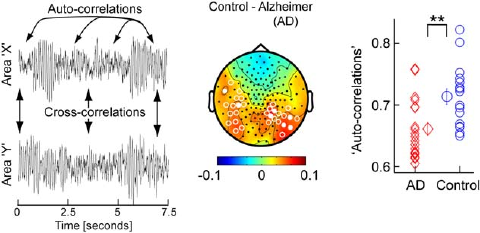
Long-range temporal correlations have been found to be impaired in major depressive disorder (Linkenkaer-Hansen et al., 2005), epilepsy (Monto et al., 2007), Alzheimer’s disease (Montez et al., 2009), and schizophrenia (Nikulin et al., 2012). Smit et al. (2011) also showed that the strength of LRTC in alpha and beta oscillations increases from age 5 to 25 and thereafter remains stable, suggesting that LRTC can be used to study abnormal brain development in conditions such as ADHD or schizophrenia.
Neuronal avalanches. The second line of evidence is based on the observation of neuronal avalanches — cascades of local field potentials that follow power-law size distributions. In 2003, Beggs and Plenz reported measurements of the spontaneous local field potentials in organotypic cultures from coronal slices of rat somatosensory cortex and in acute coronal slices of rat brains. They showed that the activity propagated in what they coined “neuronal avalanches”, and that the number of avalanches as a function of avalanche size followed a power law with an exponent of about 1.5 (Beggs and Plenz, 2003). Similar results have been found in vitro (Mazzoni et al., 2007; Pasquale et al., 2008; Shew et al., 2011; Yang et al., 2012) and in vivo in monkeys (Plenz and Thiagarajan, 2007; Petermann et al., 2009), suggesting that avalanche-like activity may be a recurring property of neuronal networks.
Connecting the two: multi-level criticality#
A key question was whether power-law scaling at these different organisational levels — avalanches and oscillations — could be related. In Poil et al. (2012), we showed that critical-state dynamics of avalanches and oscillations jointly emerge in a neuronal network model when excitation and inhibition are balanced. The oscillatory activity of the model was qualitatively similar to what is typically observed in recordings of human resting-state MEG. We proposed that homeostatic plasticity mechanisms tune this balance, and that it is essential for critical behaviour on multiple levels of neuronal organisation.
Scale-free dynamics have also been observed in other parameters (Kello et al., 2010): in the decay of temporal correlations in behavioural performance (Gilden, 2001), in phase-locking intervals between brain regions (Gong et al., 2003; Kitzbichler et al., 2009), and in fMRI signals (He et al., 2010).
See also: Introduction to Self-Organised Criticality
References#
Abbott LF, Rohrkemper R (2007) A simple growth model constructs critical avalanche networks. Prog Brain Res 165:13–19.
Bak P (1996) How nature works: the science of self-organized criticality. Copernicus, New York.
Bak P, Tang C, Wiesenfeld K (1987) Self-organized criticality: an explanation of the 1/f noise. Phys Rev Lett 59:381–384.
Beggs JM (2008) The criticality hypothesis: how local cortical networks might optimize information processing. Philos Trans R Soc A 366:329–343.
Beggs JM, Plenz D (2003) Neuronal avalanches in neocortical circuits. J Neurosci 23:11167.
Beggs JM, Plenz D (2004) Neuronal avalanches are diverse and precise activity patterns that are stable for many hours in cortical slice cultures. J Neurosci 24:5216–5229.
Beggs JM, Timme N (2012) Being critical of criticality in the brain. Front Physiol 3.
Bornholdt S, Röhl T (2003) Self-organized critical neural networks. Phys Rev E 67:066118.
Chialvo DR (2004) Critical brain networks. Phys A 340:756–765.
Chialvo DR (2006) Psychophysics: are our senses critical? Nat Phys 2:301–302.
Chialvo DR (2007) The brain near the edge. AIP Conf Proc 887:1–12. doi:10.1063/1.2709580
Chialvo DR, Bak P (1999) Learning from mistakes. Neuroscience 90:1137–1148. doi:10.1016/S0306-4522(98)00472-2
Chialvo DR (2010) Emergent complex neural dynamics. Nat Phys 6:744–750.
Christensen K, Moloney NR (2005) Complexity and criticality. Imperial College Press.
Dayan P, Abbott LF (2001) Theoretical neuroscience. MIT Press.
Gilden DL (2001) Cognitive emissions of 1/f noise. Psychol Rev 108:33–56.
Gireesh ED, Plenz D (2008) Neuronal avalanches organize as nested theta- and beta/gamma-oscillations during development of cortical layer 2/3. PNAS 105:7576–7581.
Gong P, Nikolaev AR, van Leeuwen C (2003) Scale-invariant fluctuations of the dynamical synchronization in human brain electrical activity. Neurosci Lett 336:33–36.
Haldeman C, Beggs JM (2005) Critical branching captures activity in living neural networks and maximizes the number of metastable states. Phys Rev Lett 94:58101.
Hardstone R, Poil SS, Schiavone G, Jansen R, Nikulin VV, Mansvelder HD, Linkenkaer-Hansen K (2012) Detrended fluctuation analysis: a scale-free view on neuronal oscillations. Front Physiol 3.
Hahn G, Petermann T, Havenith MN, Yu S, Singer W, Plenz D, Nikolić D (2010) Neuronal avalanches in spontaneous activity in vivo. J Neurophysiol 104:3312–3322.
He BJ, Zempel JM, Snyder AZ, Raichle ME (2010) The temporal structures and functional significance of scale-free brain activity. Neuron 66:353–369.
Kello CT, Brown GDA, Ferrer-i-Cancho R, Holden JG, Linkenkaer-Hansen K, Rhodes T, Van Orden GC (2010) Scaling laws in cognitive sciences. Trends Cogn Sci 14:223–232.
Kinouchi O, Copelli M (2006) Optimal dynamical range of excitable networks at criticality. Nat Phys 2:348–351.
Kitzbichler MG, Smith ML, Christensen SR, Bullmore E (2009) Broadband criticality of human brain network synchronization. PLoS Comput Biol 5:e1000314.
Linkenkaer-Hansen K, Monto S, Rytsälä H, Suominen K, Isometsä E, Kähkönen S (2005) Breakdown of long-range temporal correlations in theta oscillations in patients with major depressive disorder. J Neurosci 25:10131–10137.
Linkenkaer-Hansen K, Nikouline VV, Palva JM, Ilmoniemi RJ (2001) Long-range temporal correlations and scaling behavior in human brain oscillations. J Neurosci 21:1370.
Linkenkaer-Hansen K, Smit DJA, Barkil A, van Beijsterveldt TEM, Brussaard AB, Boomsma DI, van Ooyen A, de Geus EJC (2007) Genetic contributions to long-range temporal correlations in ongoing oscillations. J Neurosci 27:13882–13889.
Mazzoni A, Broccard FD, Garcia-Perez E, Bonifazi P, Ruaro ME, Torre V (2007) On the dynamics of the spontaneous activity in neuronal networks. PLoS One 2:e439.
Montez T, Poil SS, Jones BF, Manshanden I, Verbunt JPA, van Dijk BW, Brussaard AB, van Ooyen A, Stam CJ, Scheltens P, Linkenkaer-Hansen K (2009) Altered temporal correlations in parietal alpha and prefrontal theta oscillations in early-stage Alzheimer disease. PNAS 106:1614.
Monto S, Vanhatalo S, Holmes MD, Palva JM (2007) Epileptogenic neocortical networks are revealed by abnormal temporal dynamics in seizure-free subdural EEG. Cereb Cortex 17:1386.
Nikulin VV, Brismar T (2004) Long-range temporal correlations in alpha and beta oscillations: effect of arousal level and test-retest reliability. Clin Neurophysiol 115:1896–1908.
Nikulin VV, Jönsson EG, Brismar T (2012) Attenuation of long-range temporal correlations in the amplitude dynamics of alpha and beta neuronal oscillations in patients with schizophrenia. NeuroImage.
Pasquale V, Massobrio P, Bologna LL, Chiappalone M, Martinoia S (2008) Self-organization and neuronal avalanches in networks of dissociated cortical neurons. Neuroscience 153:1354–1369.
Petermann T, Thiagarajan TC, Lebedev MA, Nicolelis MAL, Chialvo DR, Plenz D (2009) Spontaneous cortical activity in awake monkeys composed of neuronal avalanches. PNAS 106:15921.
Plenz D, Thiagarajan TC (2007) The organizing principles of neuronal avalanches: cell assemblies in the cortex? Trends Neurosci 30:101–110.
Poil SS, van Ooyen A, Linkenkaer-Hansen K (2008) Avalanche dynamics of human brain oscillations: relation to critical branching processes and temporal correlations. Hum Brain Mapp 29:770–777.
Poil SS, Jansen R, van Aerde K, Timmerman J, Brussaard AB, Mansvelder HD, Linkenkaer-Hansen K (2011) Fast network oscillations in vitro exhibit a slow decay of temporal auto-correlations. Eur J Neurosci 34:394–403.
Poil SS, Hardstone R, Mansvelder HD, Linkenkaer-Hansen K (2012) Critical-state dynamics of avalanches and oscillations jointly emerge from balanced excitation/inhibition in neuronal networks. J Neurosci 32:9817–9823.
Shew WL, Plenz D (2012) The functional benefits of criticality in the cortex. Neuroscientist.
Shew WL, Yang H, Petermann T, Roy R, Plenz D (2009) Neuronal avalanches imply maximum dynamic range in cortical networks at criticality. J Neurosci 29:15595–15600.
Shew WL, Yang H, Yu S, Roy R, Plenz D (2011) Information capacity and transmission are maximized in balanced cortical networks with neuronal avalanches. J Neurosci 31:55.
Smit DJA, de Geus EJC, van de Nieuwenhuijzen ME, van Beijsterveldt CEM, van Baal GCM, Mansvelder HD, Boomsma DI, Linkenkaer-Hansen K (2011) Scale-free modulation of resting-state neuronal oscillations reflects prolonged brain maturation in humans. J Neurosci 31:13128–13136.
Turrigiano G (2012) Homeostatic synaptic plasticity: local and global mechanisms for stabilizing neuronal function. Cold Spring Harb Perspect Biol 4.
Yang H, Shew WL, Roy R, Plenz D (2012) Maximal variability of phase synchrony in cortical networks with neuronal avalanches. J Neurosci 32:1061–1072.