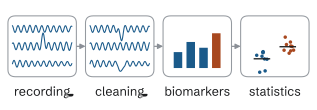
Simon-Shlomo Poil
I work on one question: how to understand the state of a complex system when its most important properties are not directly visible.
I studied biophysics, and my research in computational neuroscience at VU University Amsterdam asked whether neuronal networks operate near a critical point, why brain rhythms carry correlations over minutes, and whether those correlations can serve as biomarkers of brain disorders.
Two lessons from that work stay with me: weak signals often become informative only when they are interpreted together, and a method becomes valuable at scale only when others can reuse it without breaking it. That is why we built the Neurophysiological Biomarker Toolbox (NBT). It is no longer maintained, but its core methods live on in the tutorials here.
Today the same question returns in AI: how do you know whether a deployed system is still healthy?
Contact: LinkedIn.
Criticality
Branching Processes: How Cascades Propagate
A primer on branching processes: the model that decides whether activity in a connected system dies out, persists or explodes.
Introduction to Self-Organised Criticality
How systems of many interacting parts reach, on their own, a state with disturbances on all scales: self-organised criticality, and where it is proposed.
The Brain as a Critical System
An overview of the evidence that the brain operates near a critical state, and why this matters for understanding brain disorders.
Tools and publications
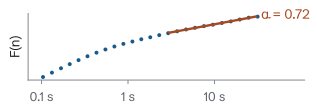
Detrended Fluctuation Analysis (DFA): A Tutorial
How to compute detrended fluctuation analysis (DFA) on the amplitude envelope of neuronal oscillations, in Python with crosci or in MATLAB with NBT.
Journal papers
All journal papers, by theme: criticality and temporal dynamics, clinical EEG biomarkers and resting-state imaging, with free full text where available.
Neurophysiological Biomarker Toolbox (NBT)
An open-source MATLAB toolbox for computing and combining biomarkers from EEG and MEG recordings.